01 / Collaborative software development
FabTandem.
Part of my application-development portfolio, created through collaborative software development.
Visit fabtandem.comSoftware & app development / Christopher Lamb
Applications I create and co-develop, bringing manufacturing experience and practical workflow thinking into software.
01 / Collaborative software development
Part of my application-development portfolio, created through collaborative software development.
Visit fabtandem.com02 / Independent application development
A manufacturing job-review and quoting application connecting opportunity data, CAD evidence, shop economics, materials, and production capacity.
The problem it addresses
Can we make it, make money, and deliver it?
The app brings those questions together. It reviews machine envelope and capability, tolerances, material costs, expected profit, data quality, and schedule slack before a job moves toward production.
Instead of relying on one attractive margin number, the decision view exposes blockers, assumptions, conservative and best-case costs, and the next review action.
Inside the actual application
The demo opens the app’s real components. Guided views jump to job review, Engine DFM, cost scenarios, capacity optimization, and workflow.
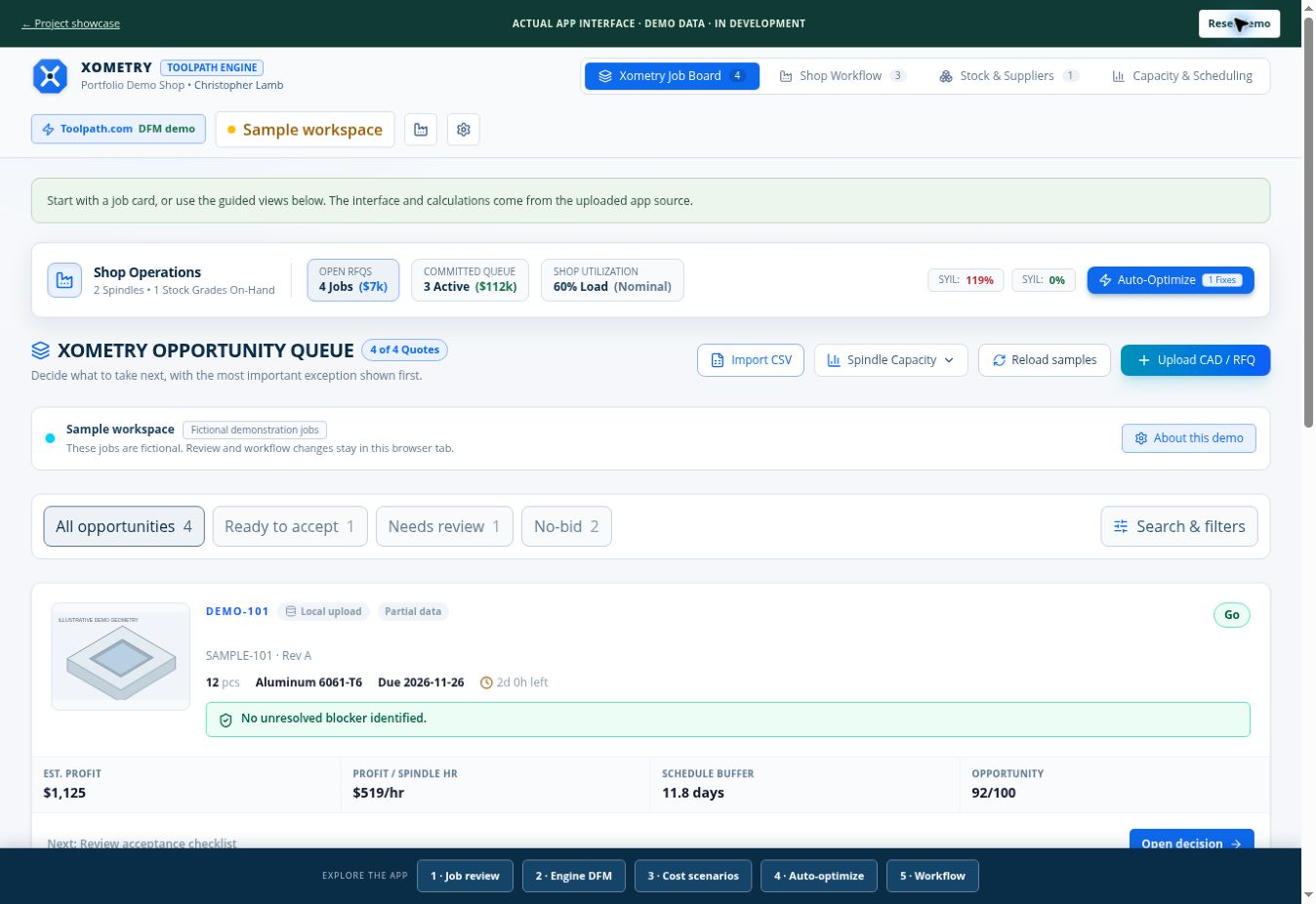 Open the interactive app demonstration
Prepared fictional jobs and an illustrative CAD model are used throughout. Sample report loading and workflow changes stay in the browser. Live vendor connections and AI requests are not enabled in this showcase.
Automation in the source project
The uploaded project includes these application paths. Live integration outcomes still require account access and end-to-end validation.
Server routes handle authorized Xometry jobs and offers, CSV/JSON import, and supported webhook updates. The local decision engine produces Go, Review, or No-go results from unresolved issues.
The integration code creates a Toolpath part upload, queues feature processing, follows job events, and retrieves feature details, candidate machining directions, and mesh metadata.
Local calculations model stock, material removal, setup, machining, engineering labor, tooling, outside processing, and margin. Cost scenarios expose uncertainty; multi-line reviews retain the worst unresolved issue.
Inventory matching and supplier budget comparisons help review the stock purchase, available quantity, and material cost. Budget estimates remain distinct from verified supplier prices.
The app’s heuristic optimizer reviews compatible spindle assignments and modeled load. Before/after views show utilization, overload, overtime, and assignment changes for review.
A production Kanban, planning travelers, setup sheets, and actual-cost records connect review with the work that follows. Offer acceptance in the source app requires a person’s confirmation.
A deliberate distinction
The supplied project explicitly separates Toolpath Engine DFM results—features, directions, and mesh data—from the app’s local cycle-time and cost estimates.
The current integration in this project does not obtain CAM operations, feeds and speeds, vendor tool selections, or Fusion-ready toolpaths from Engine DFM. The showcase preserves that boundary.
Use “Engine DFM” and “Cost scenarios” to compare the viewsDevelopment status
This is a development showcase, not a claim of production readiness or measured business results.
Why I built it
This project brings together my manufacturing background and application development: translate a shop problem into data and rules, make the analysis understandable, and support the person accountable for the outcome.
Independent project by Christopher Lamb. Vendor names identify integration targets and do not imply affiliation or endorsement.